
In many of our conversations with IT leaders today, one line keeps coming back to us: "Even if the model gets better, it's only as good as the data you feed it." The leaders making real progress with AI weren't the ones with the best models. They were the ones who had fixed something underneath first.
In our post on the five stages of AI maturity, we said your weakest foundation sets the pace of your AI adoption and how quickly you can extract value out of AI. This post explains what we mean. Every stage of AI maturity rests on the same four foundations.
Most AI budgets go to the visible part: the agent, the demo, the use case. Far less goes to the invisible part: data access, evaluation and governance. The agent demos well, then can't be validated, trusted or reused.
The cost shows up later. Without shared foundations, every new agent repeats the same access, review and validation work. The twentieth pilot costs about as much as the first, and the cost curve never bends.
With them, the tenth agent ships in a fraction of the time the first one took. Foundations are also far cheaper to build before agents multiply than after.
An agent decides and acts on what it can see. If the data is wrong or disconnected, it acts quickly on a wrong picture of the business. One speaker at the Reuters event described a thousand phantom physician names corrupting an orchestration program.
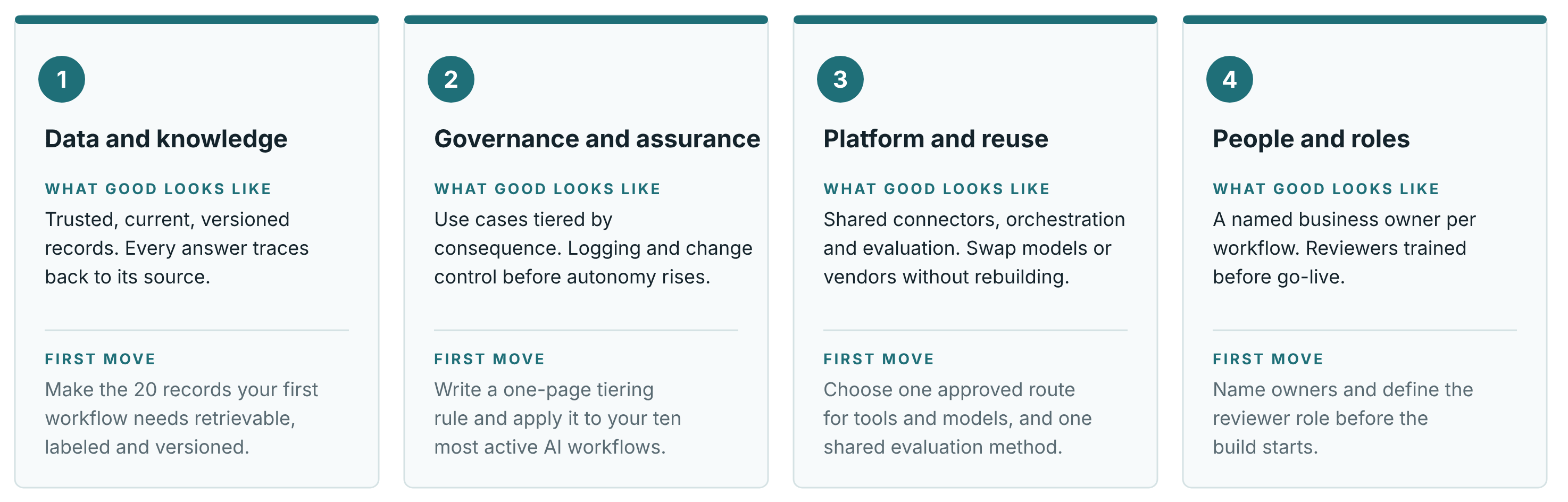
What good looks like: agents reach trusted, current, labeled documents and records, through access that respects each user's permissions. Controlled documents carry their version and status. Every answer can be traced to its source.
A sensible first move: pick the 20 documents and records your first workflow depends on. Make them reliably retrievable, labeled and versioned.
You don't need to fix all your data. You need to fix the data one workflow stands on.
Most companies govern AI with one policy for everything. Tight controls push people toward unapproved tools. Loose controls expose high-stakes work to risks nobody has sized. Both fail.
What good looks like: use cases are tiered by consequence. Validation is risk-based and fit for intended use. Changes to models, prompts and data go through change control. Logging, monitoring and an incident process exist before autonomy rises, not after.
A sensible first move: write a one-page tiering rule and apply it to your ten most active AI workflows.
A tool that summarizes meeting notes and a tool that drafts a complaint assessment should not face the same review. A one-page rule is enough to make that distinction real.
The SaaS habit is hard to break: one tool, one team, one task. Most pharma companies now run seven or more disconnected systems, and each comes with its own AI. "Email AI recommends another email; webinar AI recommends another webinar."
What good looks like: teams build on shared components, such as connectors, orchestration, evaluation tests and logging. The company can change models or vendors without rebuilding workflows.
A sensible first move: choose one approved route for tools and models, and one shared evaluation method.
This is what makes the second workflow cheaper than the first. It also protects you as models change every few months.
This is the foundation most often skipped, and the one that decides whether anything sticks. Adoption decays almost immediately after go-live unless end users help design the workflow and someone keeps managing the change. A top-10 pharma field team at the Reuters event learned this the hard way. Their lesson was "going slower to go fast."
What good looks like: every workflow has a named business owner and a named quality owner. Reviewers and supervisors are trained before deployment. Metrics reward decision quality, not throughput.
A sensible first move: name owners for your first workflow and define the reviewer role before the build starts.
Stalled programs are usually held back by one foundation, most often data or governance, rather than by the model. So don't try to fix all four at once. Ask four questions about the one workflow you care about most:
The first "no" is your weakest foundation. Fix it for that workflow, then move on.
The common trap is to treat foundations as a separate program that starts after the pilots prove value. By then, each pilot has built its own workaround. Budget for foundations as part of the first workflow, not after it.
Moving up the AI maturity curve is an operating-model change, not a technology purchase. The foundations are where that change happens.
AI earns its place the same way any investment does: by running in production and moving a number the business already tracks. A demo doesn't count. Neither does a new "AI metric" invented to make the pilot look good.
The four foundations are what make that proof possible:
Set the KPI and the baseline before the build starts. Then measure the workflow in production against it. If the number moves, widen the scope. If it doesn't, you've learned that cheaply.
Our field guide, AI That Earns Its Place, includes a 20-minute self-check that places each function on the five stages and checks your four foundations. Get the field guide → Or contact us to talk through where to start.


