
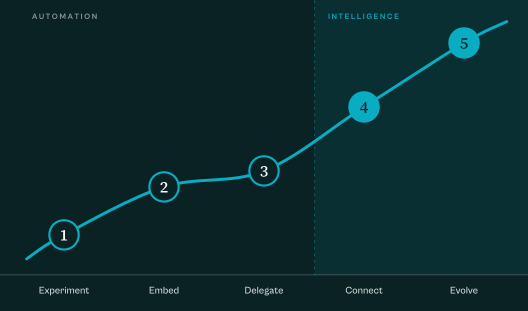
Despite the huge time and cost investments, many enterprise are still not getting measurable ROI out of AI. Everyone is using ChatGPT, Claude, Gemini, etc. with their personal productivity tasks but the true power of agentic orchestration at the organizational level is often stalls.
The gap is rarely the technology. Models keep getting better, and vendors keep shipping. This post walks through why AI adoption stalls, the five stages of AI maturity that Accellor uses to diagnose where value is (and isn't) showing up, and what it takes to move up the curve to get measurable business benefits.
Gartner expects over 40% of agentic AI projects to be canceled by the end of 2027, citing rising costs, unclear business value and weak risk controls. Three patterns sit behind that number, and none of them is a technology problem.
AI pilots multiply faster than anyone can govern them. Each one is sponsored locally, built on its own tooling and proven in a demo. Because the pilots share no data layer, no governance model and no common way to evaluate results, the twentieth pilot costs about as much to start as the first.
Value shows up as anecdotes rather than outcomes, so leadership can't tell which pilots deserve to scale. Visible activity is not progress.
Most companies govern AI in one of two ways, and both fail. Tight, uniform controls block safe, low-risk uses and push people toward unapproved tools. Loose, uniform controls expose high-stakes work to risks nobody has sized.
A tool that summarizes meeting notes and a tool that drafts a customer complaint assessment should not face the same review. Controls should rise with autonomy and consequence.
Vendors now use the word "agent" for chatbots, rules engines and genuinely autonomous systems alike. Gartner calls this "agent washing" and estimates that only about 130 of the thousands of agentic AI vendors are real. Buyers who can't tell what they are buying can't price the risk.
Underneath all three is a familiar habit. Most companies are adopting AI the way they adopted SaaS: one tool, one team, one task at a time. Each function gets its own AI, but a finding in one function still reaches the next by email and meetings. That's progress, but it isn't transformation.
Each stage is defined by a change in who does the work and who is accountable for it, not by how advanced the technology is. In the first three stages, AI does more of the work: that's automation. In the last two, functions start sharing what AI learns, and the enterprise learns as a whole: that's intelligence.
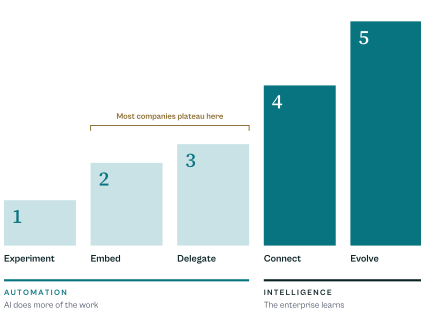
Individuals use chat assistants to draft, summarize and search. A few teams run pilots. Nobody owns the picture across the company, and rules for approved tools and data are unclear.
The risk isn't that people are experimenting. It's that nobody can see what data is going where. You're here if you have many pilots, no single owner, and Legal, IT and Quality disagree on what's allowed.
The company picks a high-volume workflow and puts AI inside it, such as triaging complaints or drafting responses to inbound requests. People stop doing the most mechanical work and focus on exceptions and quality. This is the first stage that changes how a team operates.
Measure cycle time, rework rate and reviewer override rate against the manual baseline. Watch for reviewers who rubber-stamp output, and savings counted before quality is shown.
An agent now gathers inputs, takes several steps and prepares the result. Think of an agent that compiles a complaint file, checks it against reporting criteria and drafts the assessment for a person to decide. The expert stops assembling and starts supervising, deciding and signing off.
This is where roles change, and where the consequence of the work starts to determine how far autonomy can go. Watch for permissions that creep beyond approved scope, and supervisors without the time or training to challenge the agent.
Most companies stall here. Task agents and point SaaS solutions will get you to Stage 2 or 3, but no further. Each workflow's AI works around its own data gaps, and none of them fixes the shared problem.
Functions begin to inform each other continuously instead of through periodic reports. A field complaint trend reaches design, quality, service and sales. A supply disruption informs planning before anyone schedules a meeting.
Each function still owns its decisions. What changes is what each one knows when it decides, and how fast. The key metric is time from signal to decision-maker.
Outcomes feed back into processes, models and decisions on a governed cadence, and work is redesigned around human-agent teams. Process owners propose redesigns from agent and outcome data, and roles and incentives get rewritten, not just tools.
Few companies are here. Treat it as a direction, not a near-term target.
A company is rarely at one stage everywhere. You might be at Stage 3 in commercial operations and Stage 1 in quality. Assess each function on its own, and plan accordingly.
Building the right tools and choosing the right models isn't enough. AI high performers redesign the work, not just the tooling. Here's what that takes.
The real unlock comes when AI is built into existing workflows and processes. That means AI needs to be:
One rule anchors everything: autonomy is earned, and capped by consequence. A system gets more freedom as it proves reliable, but never more than the cost of a mistake allows.
Moving up the stages changes who does the work. It does not lift the cap on a high-consequence decision.
Before you sign with any vendor or implementation partner, ask three questions:
A vendor that can't answer precisely is likely selling an assistant under an agent label. That may still be the right product, but price and govern it as what it is.
An agent decides and acts on what it can see. If the data is wrong or disconnected, it acts quickly on a wrong picture of the business. In Salesforce's 2026 survey, 96% of IT leaders agreed that the success of AI agents depends on data integration across systems.
A workflow's data is ready for an agent when each customer, product and location has one authoritative record, agents reach it through governed APIs, and each data domain has a named owner who corrects errors.
Every stage rests on four foundations, and the weakest one sets your pace:
The common trap is funding the visible part (the agent) and underfunding the invisible part (data access, evaluation and governance). The agent demos well, then can't be trusted or reused. With the foundations in place, the tenth agent ships in a fraction of the time the first one took.
Moving up one stage starts with one workflow:
Pilots aren't progress. The enterprises that get real value from AI treat it as an operating-model change, not a technology purchase. They know where each function sits on the curve, match autonomy to consequence, and build the shared foundations that let each new use case ship faster than the last.
Want to know where your organization stands? Accellor's field guide, AI that Earns its Place, includes a 20-minute self-check to place each function on the five stages. Bring your score to a 30-minute conversation with our team, and we'll help you pick the one workflow to start with.


