
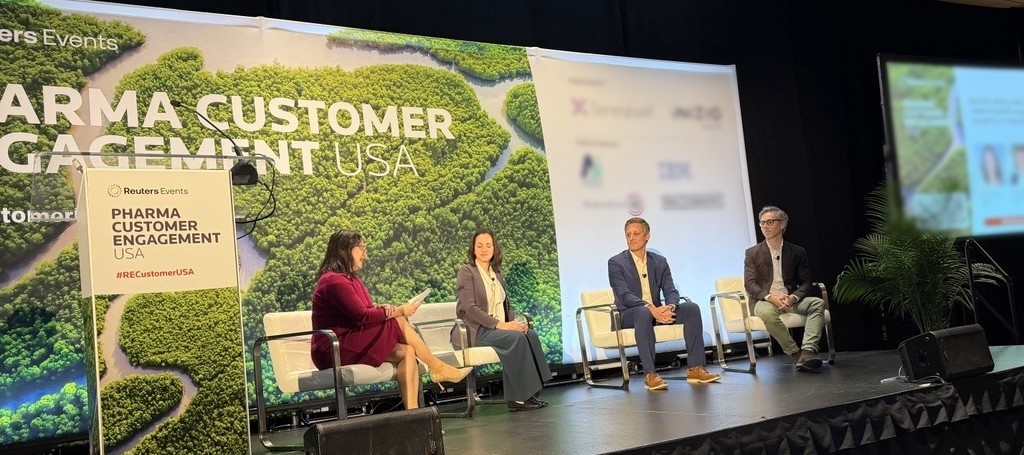
We spent two days in Philadelphia at Reuters Events Pharma Customer Engagement USA 2026, and AI came up in nearly every session. But the most useful thing we heard wasn't about models or agents. The technology isn't what's holding pharma back. The companies making real progress had fixed something else first: how their teams are organized, how they're rewarded, and whether their data can be trusted. It's the same pattern we wrote about in our recent post: plenty of AI pilots, little change to how reps actually work. Here are five lessons from the sessions.
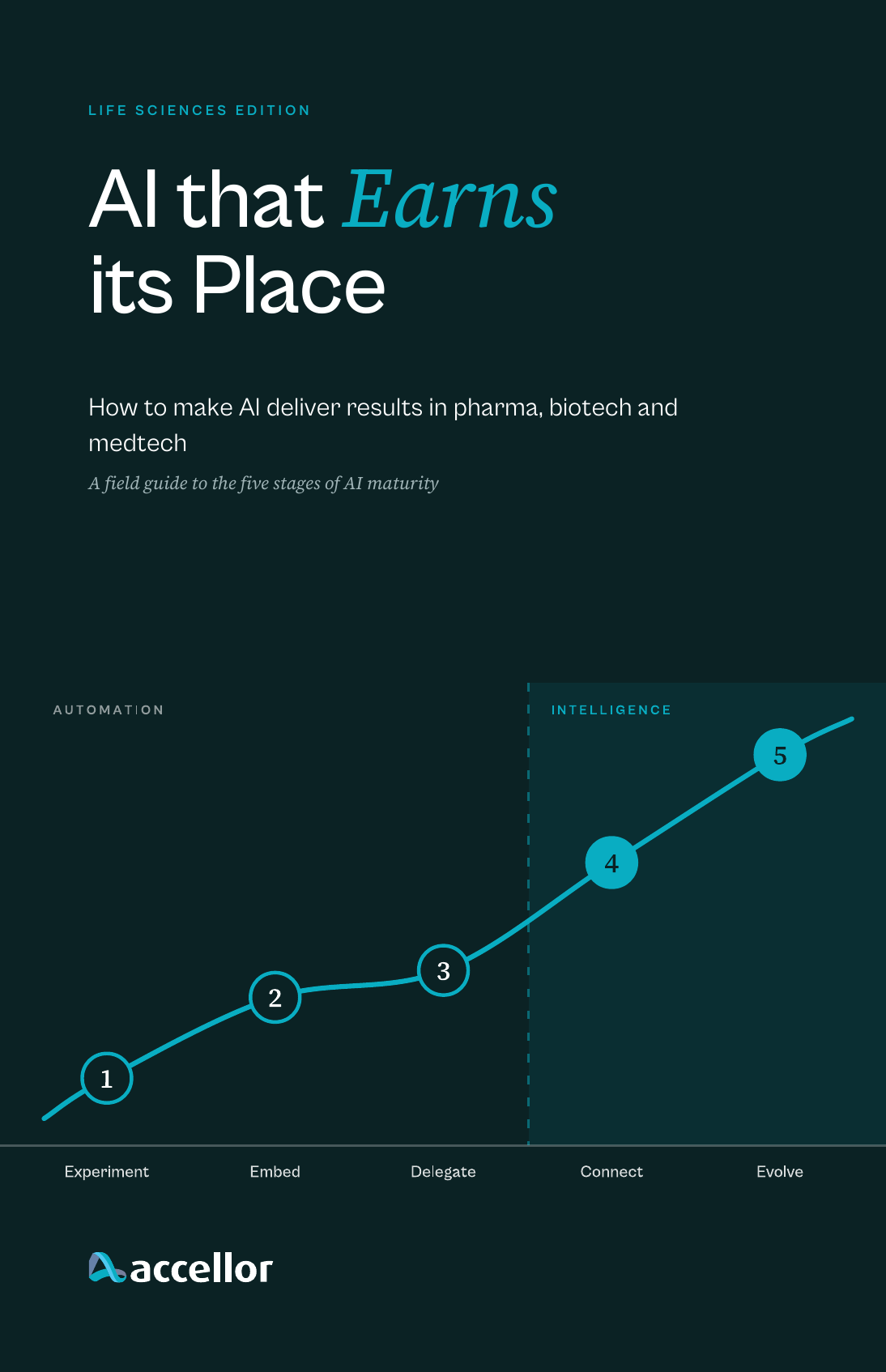
Free field guide: AI That Earns Its Place (Life Sciences Edition)
A 40-page guide for pharma, biotech and medtech leaders: the five stages of AI maturity, why most programs stall between Stages 2 and 3, a 20-minute self-check and a 90-day plan.
Get the field guide →
Most pharma companies run seven or more disconnected systems, a data and AI session pointed out, and each now comes with its own AI. "Email AI recommends another email; webinar AI recommends another webinar." Every AI works in its own little area and do not talk to each other. Connect the data, and AI can make comprehensive recommendations across channels.
Speakers offered a simple test for AI-ready data: connected, contextual, current, compliant and consumable. Context is the step most often missed. Panelists were just as blunt about output: "10,000 dashboards with no actionable output is waste." Start with the person who will use the insight and work backward. As one speaker put it, "Even if the model gets better, it's only as good as the data you feed it."
A top-10 pharma field team described building a new cross-functional engagement model for a novel therapy in about three months. It worked, but it moved too fast: no back-end tech support, no change management, and a frustrated field team. Their lesson was "going slower to go fast." To bring the team along, they now aim for 80% enterprise standard and 20% custom implementation to drive adoption.
A medical-commercial panel added that individual incentives quietly undermine team collaboration. Their proposed fix is one enterprise-level North Star, sponsored from the top, with team goals derived from it.
Even organizations that are further along face this. One large pharma we spoke with has already built a secure internal AI workspace and appointed ambassadors to bring it into brand planning and research. Their challenge now is getting outcomes from a capability that already exists, and they're tying AI use to budgets and incentives to get there. That matches what we see: adoption decays almost immediately after go-live unless end users help design the workflow and someone keeps managing the change.
One agency leader called "next best action" a misnomer. Customers show up across many channels at once, so the goal is orchestrating the whole experience, not just prescribing a single step. And for complex therapies, the customer isn't just the HCP: nurses, social workers and operations staff all determine whether a patient gets treated. One panelist cited 19 reps from one company calling on a single clinic.
Another leader described the internal version of the problem as "seven systems, eight answers." Their response was one shared customer-health view (clinical, operational and economic), visible to medical, commercial and market access within compliance limits, plus one list of top accounts that every function committed to. Content matters too: "Clients spend heavily on data and tech, then show up with five banners" (this was a consultant talking about pharma). Companies spend heavily on data and tech, then show up with just five banners for promotion.
"Not everything needs AI" was a refrain. Keep the legacy systems that work, add agents where they create real value, and watch model and token costs. On the exhibit floor, "agentic" was everywhere. Buyers should ask who decides the next step, what happens when the agent fails, and what it can do without approval.
The strongest real-world examples were small, specific and well governed. One company embedded a conversational AI patient avatar in unbranded peer-to-peer programs. The biggest early hurdle wasn't compliance review but internal fear that it would offend customers, and a skeptical KOL ended up defending it. Even so, it had to be retrained to give consistent answers before it could scale.
One speaker pictured AI as concentric circles: human judgment, strategy and patient focus at the core, with agents on the outside widening what people can do. Another warned that AI pulls toward the norm, so rare or atypical patients can be missed. "Data isn't the bottleneck; decision-making under pressure is."
A direct-to-patient leader pointed to airline apps as the model: proactive, in-the-moment alerts, with the system coming to the patient. The most-wanted data set was a simple one. "We sell medicine. Shouldn't we understand if they're refilling it?"
Speakers described consented, "living" patient cohorts that replace rebuilding a study cohort each time, and reported fielding thousands of survey responses within days. Patients have app fatigue, so a link in a text message beats a download. As AI chatbots become a new source of truth in consumer health, pharma has to supply evergreen, science-based content rather than run campaigns and go dark. Human touchpoints still matter: nurse-staffed text chat was highlighted as a high-value channel, with AI as the tool, not the replacement.
Trust runs through all of it, and it erodes fast when data fails. One speaker described a thousand phantom physician names corrupting an orchestration program.
The leaders making progress design AI into the work. They fix data and incentives first, they cap autonomy by consequence, and they move deliberately. Foundations beat pilots.
Where is your team on the AI maturity curve? Download our field guide, AI That Earns Its Place, includes a 20-minute self-check. Contact us to learn more about how we can help you implement AI that delivers measurable ROI.


