
Walk any conference floor this year and you'll see the word "agentic" on nearly every booth. Gartner has a name for this: "agent washing," the rebranding of chatbots, assistants and robotic process automation as agents. It estimates that only about 130 of the thousands of agentic AI vendors are real.
This matters for more than marketing. If you can't tell what you're buying, you can't price the risk or decide how much to trust it. This post offers a plain way to think about agency: what it is, how to recognize it and how much of it to allow.
An AI system has agency when the model, not a fixed rule or a person, decides what happens next. That's the test. It's not about how impressive the output is or how natural the conversation feels.
But more agency isn't automatically better. Most of a well-designed agentic solution is not agents. Rules and predictive models make the decisions that have a right answer; the language model drafts and explains. The real skill is choosing the right intelligence for each job.
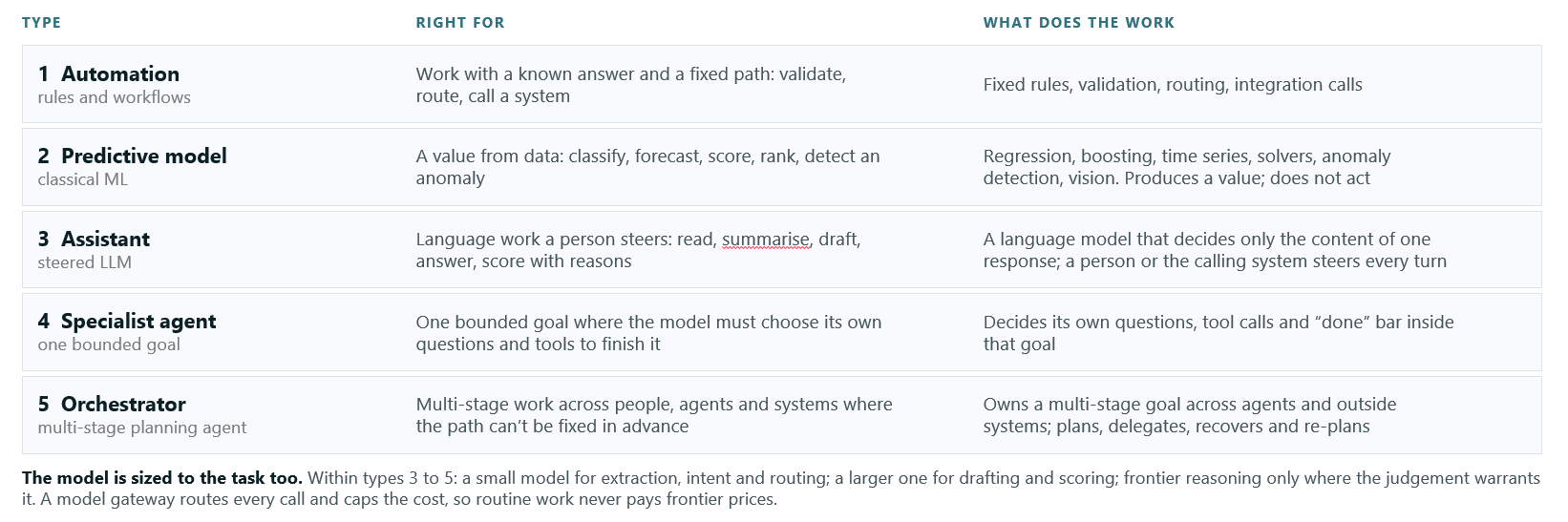
At Accellor, our approach uses five types of intelligence, from simple automation to a planning agent:
1. Automation (rules and workflows)
Right for: Work with a known answer and a fixed path: validate, route, call a system
What does the work: Fixed rules, validation, routing, integration calls
Accellor examples in production: Every purchase order validated against the ERP before an agent acts; an Oracle integration
2. Predictive model (classical ML)
Right for: A value from data: classify, forecast, score, rank, detect an anomaly
What does the work: Regression, boosting, time series, solvers, anomaly detection, vision. Produces a value; does not act
Accellor examples in production: Category prediction and supplier scoring; demand forecasting
3. Assistant (steered LLM)
Right for: Language work a person steers: read, summarize, draft, answer, score with reasons
What does the work: A language model that decides only the content of one response; a person or the calling system steers every turn
Accellor examples in production: Case insights; meeting summaries and follow-ups
4. Specialist agent (one bounded goal)
Right for: One bounded goal where the model must choose its own questions and tools to finish it
What does the work: Decides its own questions, tool calls and "done" bar inside that goal
Accellor examples in production: Specialized research agents; intake and SOW-creator agents
5. Orchestrator (multi-stage planning agent)
Right for: Multi-stage work across people, agents and systems where the path can't be fixed in advance
What does the work: Owns a multi-stage goal across agents and outside systems; plans, delegates, recovers and re-plans
Accellor examples in production: Turning Jira stories into SDLC plans; a supervisor over four research sources
Only types 4 and 5 are agentic in the full sense. Types 1 to 3 are often sold as agents, and they're often exactly what the job needs.
Start at the lowest type that can do the job, and move up only when the work demands it:
In practice, a good solution mixes all five. An orchestrator might call a specialist agent, which uses a predictive score, drafts with an assistant and checks the result against fixed rules before anything reaches a person.
The same logic applies inside types 3 to 5. Use a small model for extraction, intent and routing; a larger one for drafting and scoring; and frontier reasoning only where the judgment warrants it. A model gateway routes every call and caps the cost, so routine work never pays frontier prices.
Agency describes what a system can do. Autonomy describes what you let it do. An orchestrator can still be held to drafting, if the stakes require it.
We think about autonomy in three steps:
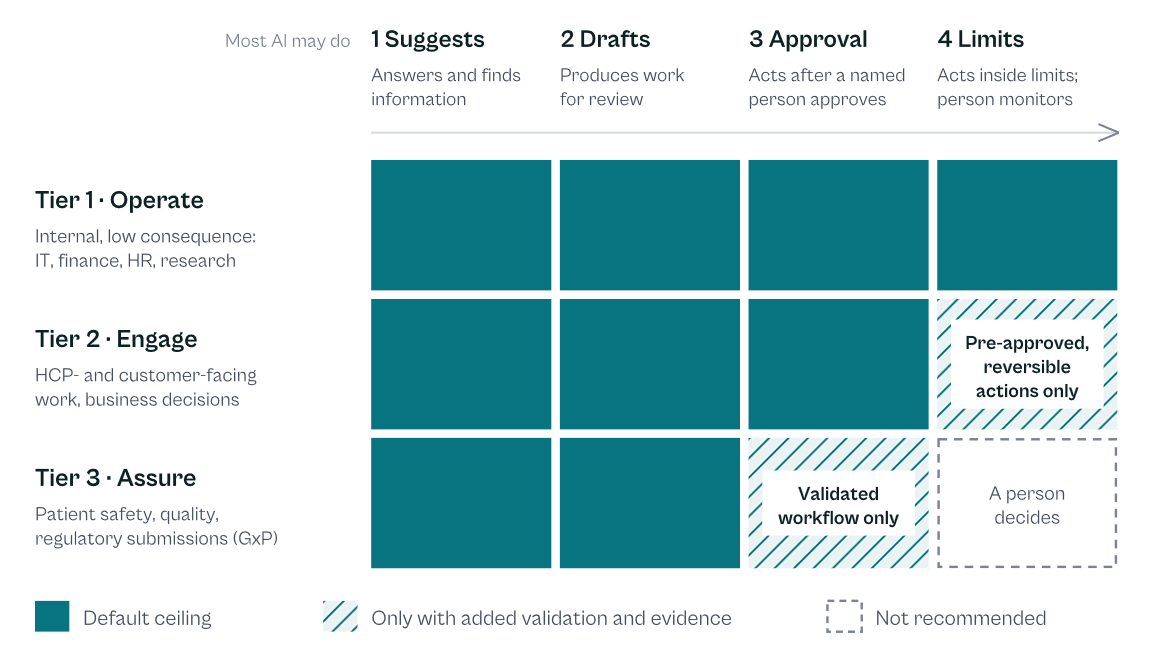
A system gets more freedom as it proves reliable, but never more than the cost of a mistake allows. Every task falls into one of three consequence tiers, and each tier sets a ceiling:
The first half of the rule, earned, means autonomy rises with evidence. Track accuracy and approval rates, and move proven actions up a step only when the numbers support it. The second half, capped, means no amount of evidence lifts a ceiling. An agent that has drafted 10,000 flawless case narratives still doesn't sign one.
The further a system sits toward an orchestrator, the more evidence you need before raising its authority in customer-facing and regulated work.
It's tempting to think that as a company moves up the AI maturity curve, AI should be trusted with more. That's only half true. Moving up the stages changes who does the work and what each function knows. It does not lift the cap on a high-consequence decision.
A Stage 4 company can have agents sharing safety signals across medical, regulatory and commercial teams. The decision on each signal still belongs to a named person.
Before you sign with a vendor or implementation partner building agents, ask:
A vendor that can't answer these precisely is likely selling automation or an assistant under an agent label. That may still be the right product. Just price and govern it as what it is.
The most useful systems we see don't rely on one agent doing everything. They're layered by responsibility: some agents do, some orchestrate and some think. Each layer gets the autonomy its consequence tier allows, and each action is logged and attributable.
That's how agency becomes something a business can trust. Not by asking whether a system is agentic, but by deciding, task by task, how much freedom it has earned.
Choosing the right type of intelligence is an ROI decision as much as a technical one. Every step up the five types adds cost: more model calls, more evaluation, more supervision and more evidence before autonomy can rise. That cost is only worth paying if it moves a KPI the business already uses.
So judge every agent the way you'd judge any other investment:
An agent that is less agentic but proven in production beats a fully agentic one still waiting for its business case.
Our field guide, AI That Earns Its Place, sets out the consequence tiers and autonomy ceilings in full, with worked examples from pharma and medtech. Get the field guide → Or contact us to pressure-test an agent you're evaluating.


